SIKIA
The listening layer for African crop breeding. SIKIA — "listen" in Swahili — captures smallholder farmer feedback by voice, text, and image in their own language, offline in the field, and turns it with AI into the structured trait data breeders actually use to decide which varieties advance.
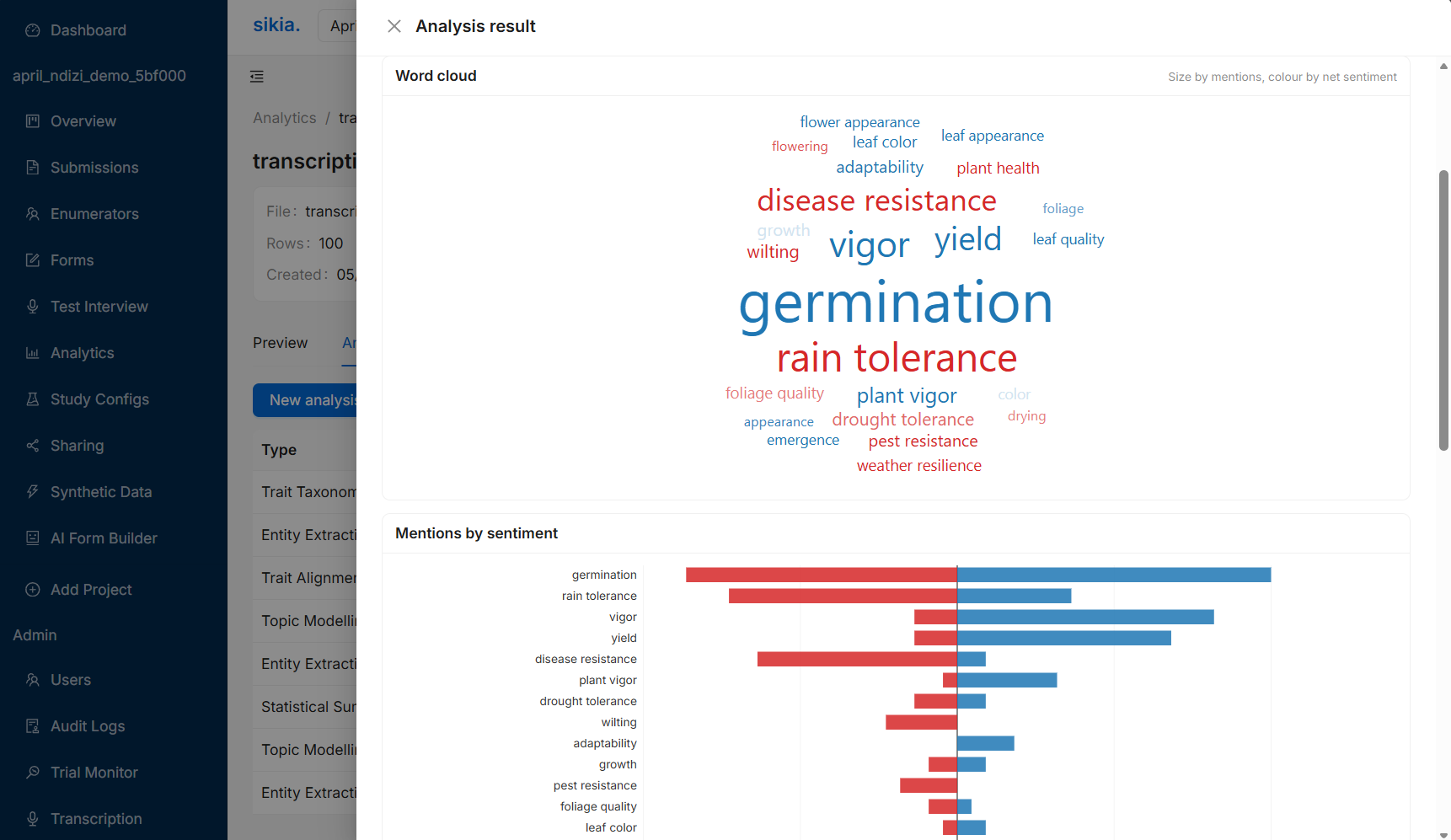
SIKIA dashboard — trait mentions and sentiment extracted from farmer responses
Breeders release the varieties farmers plant — but rarely hear from them directly.
Crop breeding programs test dozens of candidate varieties in real farmers' fields. The signal that matters most — which traits a farmer values, what they liked or disliked about a variety — usually arrives as messy voice notes, paper forms, or not at all, in low-resource languages that breeders' tools don't handle.
SIKIA is the platform behind NDIZI (NLP to Develop and Innovate Zero-shot Intelligence), a Gates Foundation–funded initiative run with the Alliance of Bioversity International & CIAT alongside partners including TARI and CIMMYT. Its goal is to close that gap — to make the farmer's own words a first-class input into breeding decisions across the languages of Africa.
Three places farmer feedback goes to die.
Trapped in voice & dialect
Farmers describe traits naturally in Swahili, Chichewa, Hausa and other low-resource languages. That richness is lost the moment it's squeezed into a checkbox — or left as audio no one transcribes.
The field is offline
Data collection happens at rural trial sites with little or no connectivity. Tools that assume a live connection simply don't work where the interviews actually take place.
Raw responses aren't analysis-ready
Even once collected, free text and audio can't be aggregated. Breeders need structured trait mentions, sentiment, and rankings they can compare across varieties — not a pile of transcripts.
From a farmer speaking, to a breeder deciding.
A three-part platform — an offline-first mobile app, an async Python backend running the AI pipelines, and a researcher dashboard — that carries a response the whole way from the field to an analysis-ready dataset.
Offline-first field capture
A Flutter app records farmer responses — voice, text, and image — with no connection required, transforming ODK XForms into simplified JSON and syncing automatically once a network returns.
AI interview agent
An LLM-driven conversational interviewer runs an XLSForm script with mid-stream persistence, self-healing idle sessions, and a full audit trail on every answer correction.
Entity & sentiment extraction
Pipelines pull trait mentions, sentiment, and emotion from free-text responses — each grounded in evidence and checked for sentiment consistency before it lands in the dataset.
Topic modelling
Open-ended answers are embedded, dimensionally reduced, clustered, and labelled to surface the themes breeders didn't think to ask about.
Researcher dashboard
A Next.js console to manage projects, enumerators, submissions, and study configs, launch analyses, and read the results as word clouds and sentiment charts.
AI form builder
Generate and import XLSForms with AI assistance, so researchers describe the survey they want instead of hand-authoring branching form logic.
ClimMob integration
Two-way sync with the ClimMob tricot platform — the system of record for the breeding trials SIKIA collects against — so field feedback flows back into the research pipeline.
Synthetic data & exports
LLM-generated synthetic submissions make the pipeline testable at scale, and results export to xlsx, JSON, SPSS, and Stata for downstream statistical analysis.
How it fits together.
An async FastAPI core sits between offline-first clients and a set of AI pipelines, with heavy analytics offloaded to a separate Cloud Run worker via Cloud Tasks — all backed by Firestore and Google Cloud Storage, and wired into ClimMob.
A pipeline that runs from a farmer speaking to a breeder deciding.
SIKIA is in active development as the data-capture and analysis backbone for NDIZI's breeding research. It replaces lossy paper-and-audio workflows with a single pipeline: a farmer speaks in their own language, offline; that response syncs, gets transcribed and structured; and a breeder reads trait sentiment on a dashboard — evidence-grounded and ready to compare across varieties.
"Breeding decisions get better when the farmer's own words make it into the data. Sikia makes sure they do."