REIMS
A Research Ethics Information Management System that took health-research approvals in Tanzania off paper and email — and grew into the connected platform for submission, review, payments, certification, and national data exchange, running across multiple institutions for over eight years.
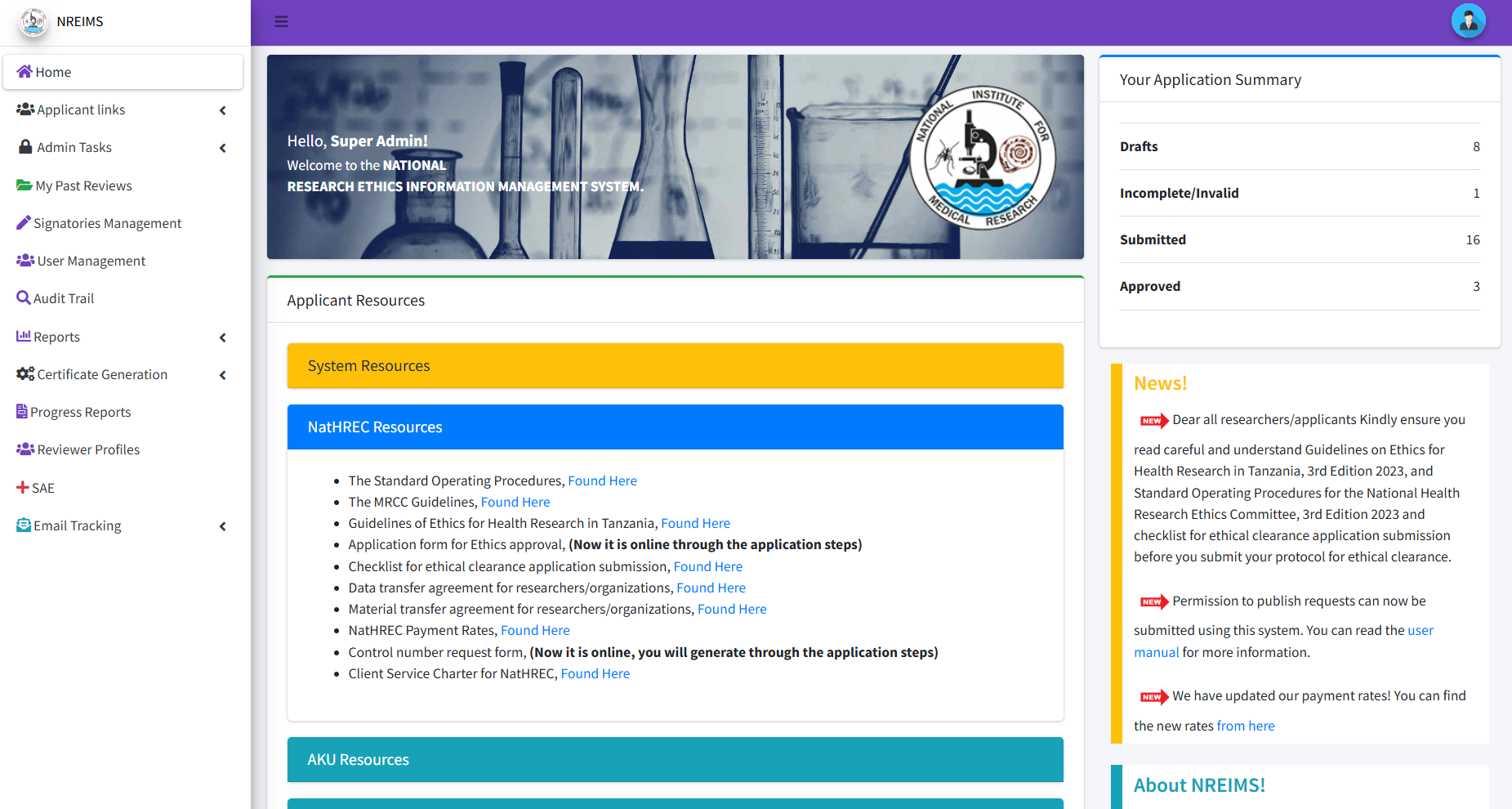
REIMS — applicant & committee dashboard
Every clinical study in Tanzania needs ethical clearance first.
Before any health research involving human participants can begin, it must be reviewed and approved by an institutional review board. For years that process ran on printed forms, physical signatures, and email chains — applications went missing, review cycles stretched for months, and no one could see where a submission actually was.
REIMS was built to make that entire lifecycle — submission, review, revision, and approval — happen in one auditable place, for both the researchers applying and the committees reviewing.
Three failures in the paper process.
No visibility
Applicants had no way to know if their submission was received, under review, or stalled — so they called and emailed constantly.
Slow, serial review
Documents moved physically between reviewers one at a time. A single committee cycle could take months to close.
No audit trail
Approvals, revisions, and comments lived across scattered paper and inboxes — impossible to reconstruct or hold to account.
One platform for applicants and committees.
I led design and development end to end — the data model, workflow engine, certificate signing, payment and government-system integrations, notifications, and both the applicant and reviewer interfaces.
Online submission
Researchers create, save, and submit protocol applications with document uploads — no printing, no physical drop-off.
Workflow engine
Submissions move through defined states — received, under review, revisions requested, approved — with the right people notified at each step.
Committee dashboard
Reviewers see their queue, read protocols, and record comments and decisions in parallel rather than passing paper around.
Automated notifications
Scheduled email alerts keep applicants informed on status changes and reviewers reminded of pending and expiring items, with Slack alerts for the operations team.
Full audit trail
Every action, comment, and decision is timestamped and attributable — the record is reconstructable end to end.
Multi-institution
Each institution runs its own committees, forms, and users on the same platform — deployed across six over time.
Digital certificates
Approved studies earn a clearance certificate through a four-step sign-off (HOD → DRIRA → DG → CMO), issued as a digitally signed, QR-verifiable PDF.
Integrated payments
Application fees are billed and reconciled straight through Tanzania's government e-payment gateway (GePG), with control numbers generated in-app.
How it fits together.
A Livewire-driven Laravel application with a relational core, wired into national government systems for identity, payments, and data exchange — with email and Slack for notifications.
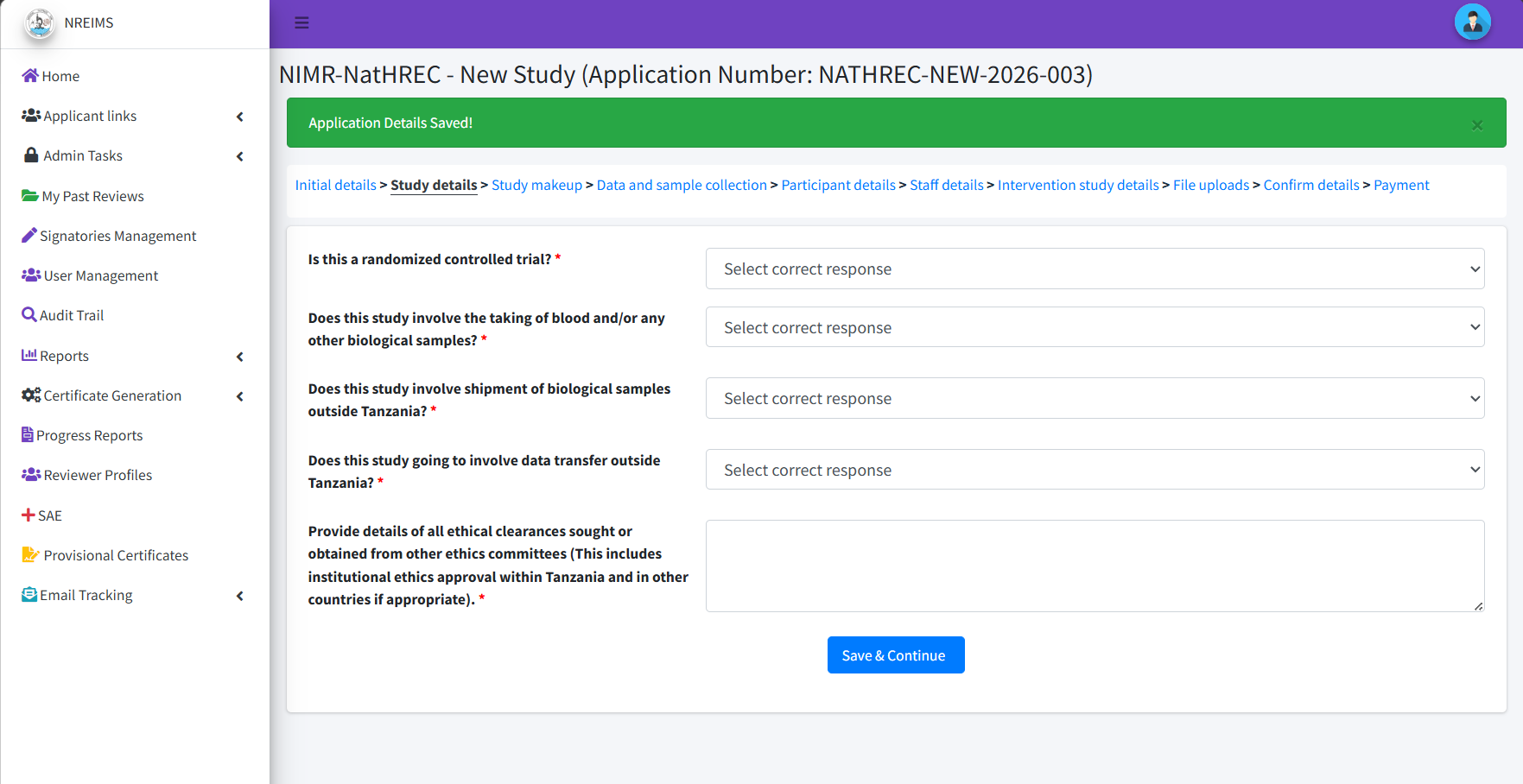
Applicant portal — new study submission
Eight years in production, and a second generation.
REIMS became the standing system of record for research-ethics approvals at the institutions that adopted it — and grew well beyond approvals into payments, national ID verification, certificate issuance, and data exchange with national health systems. It proved durable enough to justify a ground-up rewrite (REIMS v2) on a modern stack.
"The work that turned a months-long paper process into an auditable system a whole country's health research now runs on."